





Term Three 2026 school capitation
School Need Clear Spending Guidelines to Accompany Capitation Disbursements
The release of Term Three 2026 capitation funds has once again brought Kenya’s school financing system into sharp focus. While the money sent to public primary schools, Junior Secondary Schools (JSS) and Senior Schools is important, another equally critical issue deserves greater attention: the timely communication of official Ministry of Education guidelines explaining how the funds should be spent.
According to education commentator Hillary Muhalya, predictable capitation funding and clear financial instructions should reach school managers within the same timeframe. This would enable headteachers, principals, Boards of Management (BOMs) and other education officials to plan effectively, spend responsibly and maintain proper accountability.
For school administrators, a Ministry circular is much more than routine paperwork. It serves as an official financial guide that outlines the amount of money released, the vote heads receiving the funds, the approved expenditure areas and the accountability procedures that institutions must follow.
Without timely circulars, schools risk operating under uncertainty.
Public institutions cannot manage Government funds based on speculation, verbal communication, previous allocations or assumptions about how money may be used. School managers require official and written guidance before making important financial commitments.
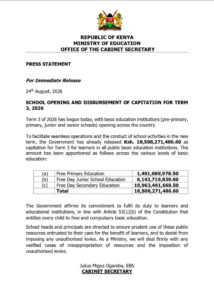
Primary Schools Receive Sh259.70 Per Learner
Under the Term Three 2026 Free Primary Education capitation programme, public primary schools are receiving Sh259.70 per learner.
The allocation is divided into two main accounts.
Account One
Account One receives Sh133.70 per learner and supports expenditure on learning materials and related needs, including:
- Textbooks and supplementary readers
- Textbook maintenance
- Exercise books
- Teachers’ guides and reference materials
- Stationery
Account Two
The second account receives Sh126 per learner and supports a wider range of operational requirements, including:
- Wages for support staff
- Renovation and maintenance
- School activities
- Local transport and travelling
- Electricity, water and conservancy
- Telephone and postage
- Environmental sanitation
- Capacity building
- Board of Management meetings
- Contingency expenses
- Science and applied technology
- Assessment and examinations
Although the total amount may appear significant at first glance, schools must spread the money across many approved expenditure areas.
For example, a school with 100 learners would receive approximately Sh25,970, while one with 300 learners would receive about Sh77,910. A primary school with 500 learners would receive approximately Sh129,850, while an institution with 1,000 learners would receive around Sh259,700.
However, these amounts should not be viewed as unrestricted funds. Each allocation is attached to specific expenditure categories, meaning school administrators must follow the approved financial framework.
JSS Funding Includes Learner Allocation and Basic Support
Junior Secondary Schools are receiving a substantially higher Term Three allocation compared to primary schools.
The latest Free Day Junior Secondary Education (FDJSE) funding framework provides Sh1,501.64 per learner, in addition to a basic allocation of Sh38,216.97 per school.
The learner-based funding supports several important areas, including repairs and maintenance, co-curricular activities, local transport, administration, medical and insurance costs, stationery, Competency-Based Education practical materials, laboratory supplies, assessments, textbooks, supplementary readers and SMASSE capacity building.
When the basic allocation is included, the figures vary depending on learner enrolment.
A JSS with 100 learners would receive approximately Sh188,380.97. An institution with 300 learners would receive around Sh488,708.97, while one with 500 learners would receive about Sh789,036.97.
For larger institutions, the figures increase considerably. A school with 1,000 learners could receive approximately Sh1.54 million, while one with 2,000 learners could receive close to Sh3.04 million.
Despite these larger figures, JSS funds are also not freely available for use on any expense. School managers must comply with the vote-head structure and financial guidelines issued by the Government.
Senior School Capitation Requires Careful Interpretation
The situation is particularly sensitive when it comes to Senior School funding.
The official annual Free Day Secondary Education (FDSE) capitation rate remains Sh22,244 per learner. However, stakeholders should be careful not to automatically convert this annual figure into a Term Three allocation.
The Government has traditionally applied a 50:30:20 capitation disbursement formula across the three school terms. While 20 per cent of the annual allocation may produce a particular mathematical figure, the actual amount released during Term Three should be confirmed through the official Ministry circular governing that specific disbursement.
This distinction is crucial for proper planning.
An annual capitation figure represents the total funding policy for the year, while the amount actually received in a particular term depends on the Government’s official release and accompanying instructions.
School managers should therefore avoid making financial commitments based purely on projected calculations before receiving official confirmation.
Why Timely Ministry Circulars Are Important
The timing of the Ministry circular can be just as important as the timing of the money itself.
School heads need accurate information on how much has been released, the specific vote heads receiving the funds, the intended expenditure areas and the financial reporting requirements.
This information forms the foundation of responsible budgeting.
When funds arrive without immediate guidance, administrators may be left uncertain about how to proceed. They may know that money has reached the school account but remain unclear about how the latest allocation should be distributed.
Such uncertainty can create avoidable financial challenges.
School heads are responsible for managing public resources and must ensure that expenditure complies with Government regulations. They cannot simply move funds from one budget line to another because an urgent need has emerged.
For this reason, timely circulars should be considered an essential part of the capitation process rather than an administrative exercise that can wait.
School Heads Face Increasing Financial Pressure
The reality on the ground is that school administrators must deal with urgent needs every day.
A leaking classroom roof may require immediate repairs. Water and electricity bills must be paid. Sanitation facilities need maintenance. Learners require exercise books and learning materials. Assessment programmes must continue, while support staff also expect their wages.
At the same time, school funds are divided across specific vote heads.
This creates a difficult balancing act for headteachers and principals.
Without clear financial guidance, a school manager may face the challenge of deciding whether to address an urgent institutional need immediately or wait for official clarification on whether the available funds can legally be used for that purpose.
A timely Ministry circular reduces this uncertainty and gives school managers a clear basis for decision-making.
Is School Capitation Enough?
The Term Three 2026 allocations have also revived a broader debate over whether capitation funding is keeping pace with the actual cost of running public schools.
The discussion should not focus only on the amount allocated per learner.
It should also consider how much money reaches the school, when it arrives, how it is divided and whether the funding reflects the current cost of educational services and operations.
For instance, a primary school with 500 learners may receive approximately Sh129,850. However, the amount must support numerous requirements, including learning materials, stationery, maintenance, sanitation, assessments, utilities and support staff.
The same financial pressure applies to Junior Secondary Schools, where a larger allocation must still be shared among many competing needs.
Predictable and timely funding is therefore essential for schools to plan procurement, maintenance, learning activities and other operations effectively.
Money and Instructions Should Reach Schools Together
The Ministry of Education should continue strengthening the capitation system by ensuring that funds and the official instructions governing their use reach schools within a reasonable and coordinated timeframe.
The two should go together.
When money arrives before the guidelines, school managers may struggle with uncertainty. When guidelines are delayed after financial commitments have already been made, administrators may face difficulties aligning expenditure with the official framework.
READ ALSO:School Heads to Become More Accountable to Education Ministry Under Proposed Law
Timely instructions benefit every stakeholder.
They strengthen Government oversight and accountability, provide school heads with a clear legal and administrative basis for expenditure, help Boards of Management perform their oversight role and ultimately protect learners, who are the intended beneficiaries of public education funding.
The Way Forward for School Capitation in Kenya
As Kenya continues to reform education financing under the Competency-Based Education system, attention should extend beyond headline budget allocations.
Success should also be measured by whether funds are released predictably, whether the amounts are adequate and whether clear spending guidelines reach institutions on time.
Schools need certainty.Parents deserve transparency in the management of public education resources. Boards of Management require clear accountability frameworks, while teachers need properly funded institutions that can support effective teaching and learning.
Most importantly, headteachers and principals need official guidance that enables them to manage public money confidently and responsibly.
The message from the education sector is therefore clear: school capitation should not be separated from the Ministry circulars that explain how the money is to be used.
For school managers, a timely circular is a financial roadmap. It provides clarity on what has been released, where the funds should be allocated and how expenditure should eventually be accounted for.That level of clarity is not optional.It is a fundamental requirement for sound financial management, stronger accountability and the protection of public resources in Kenya’s education system.
Term Three 2026 school capitation.




[…] READ ALSO:Timely Ministry Circulars Are Essential for Proper Use of School Capitation Funds […]