




HELB 2026/27 funding allocations
By Elimu News Update | September 3, 2026
The wait for thousands of first-time university and TVET students seeking government funding could be coming to an end, with reports emerging that 2026/27 HELB and HEF funding allocations are beginning to reflect on the student portal.
The development has sparked fresh excitement among students, with some applicants taking to social media to report changes in their funding status and urging others to log into their HEF accounts and check whether an allocation has been made.
However, students should be cautious about interpreting the latest reports. The allocation process appears to be underway, but there is no official evidence yet showing that all or the majority of first-time applicants have received their funding allocations.
Some first-time applicants report seeing allocations
Reports circulating among student groups indicate that some applicants are now being advised to check their HEF portals for allocation information.
The reports have mainly focused on students who had already submitted and completed their funding applications. Some applicants are reportedly seeing allocation-related information, while others continue to see statuses such as “Verified” or remain under processing.
This difference is important because applications do not necessarily move through the system at the same time.
A student whose application has already gone through assessment may see an allocation, while another applicant who submitted a similar application may still be waiting for the verification or assessment process to be completed.
HEF portal allows students to check allocation status
The reports are consistent with information provided by the official Higher Education Financing system.
The HEF portal allows applicants to track the status of their application, allocation and disbursement. The official guidance states that the amount awarded through scholarships and loans depends on the applicant’s assessed level of financial need and the cost of the programme.
This means students should not expect to receive an identical amount simply because they are joining university or TVET in the same academic year.
Students can therefore log into their HEF accounts and check whether their application has moved to the allocation stage.
789,422 applications received
The latest development comes as the government continues processing a huge number of applications for the 2026/27 funding cycle.
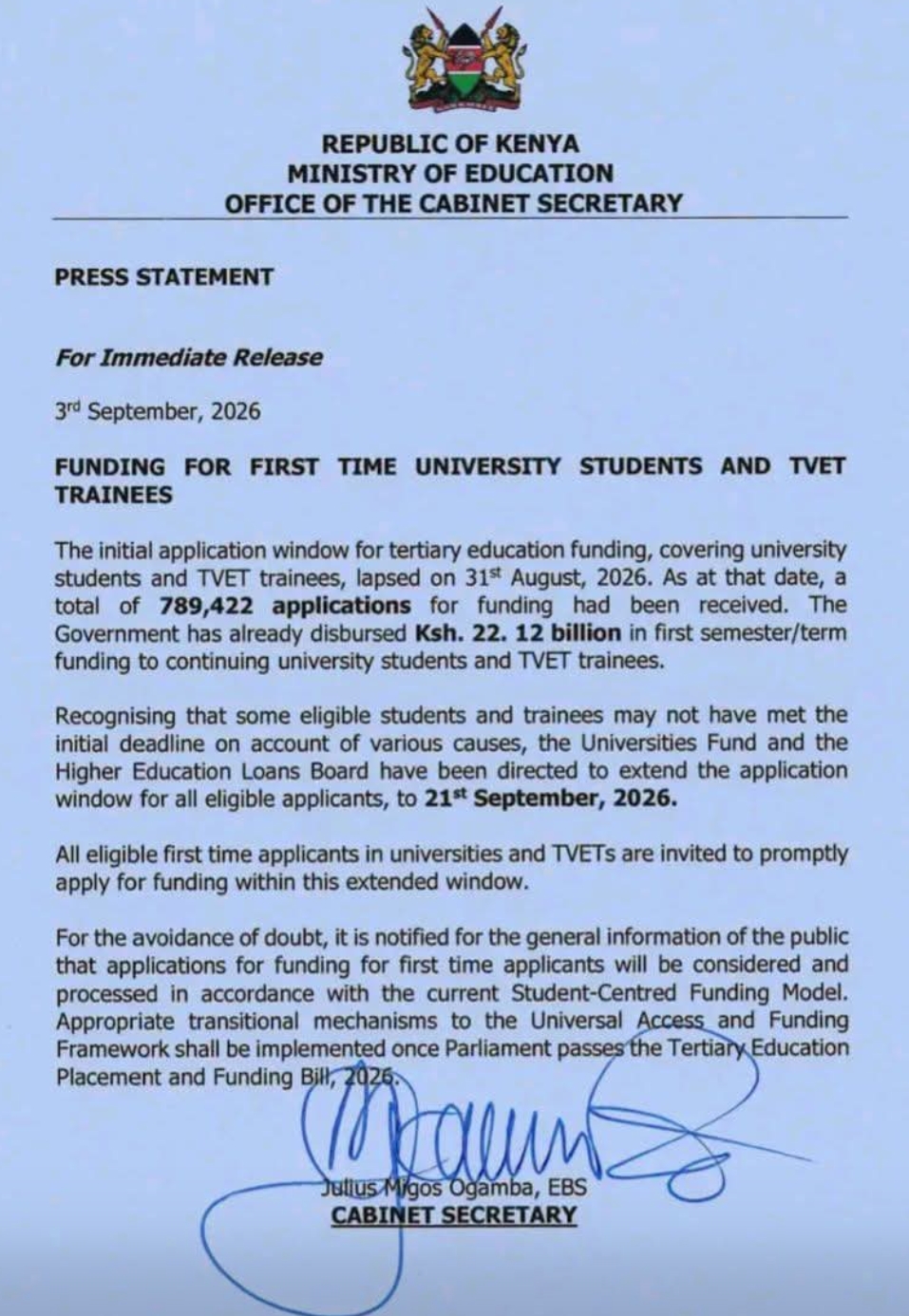
Education Cabinet Secretary Julius Ogamba said the government had received 789,422 applications by August 31, when the initial application window closed.
The figure covers first-time university students and TVET trainees seeking government financial assistance.
The government has since extended the application deadline to September 21, 2026, giving eligible students who missed the original deadline another opportunity to apply.
The extension means the number of applications will continue to change as new applicants submit their requests.
Government funding process remains under the current model
The Ministry of Education has also clarified that funding applications for first-time university students and TVET trainees will continue to be processed under the existing Student-Centred Funding Model.
This clarification comes as the government prepares for proposed changes to the tertiary education funding system. The new framework will require parliamentary approval before it can be fully implemented.
For now, applicants should therefore expect their funding to be assessed under the current system.
Allocation does not mean money has already been paid
Students should also understand the difference between allocation and disbursement.
Seeing a scholarship or loan amount on the HEF portal does not automatically mean that the money has already reached the student’s bank or mobile money account.
According to the HEF guidance, scholarship and loan disbursements are processed at the beginning of the semester, subject to confirmation by universities and TVET institutions. Tuition support is paid to institutions, while eligible upkeep support is paid to students.
Students should therefore check both their allocation and disbursement status.
Are allocations reflecting for large numbers?
At the moment, there is evidence that allocations are beginning to appear for some applicants, but it would be premature to claim that allocations have been reflected for the majority of the 789,422 applicants.
Social media reports can confirm that individual students are seeing changes, but they cannot establish the national number of applicants who have received allocations.
The safest interpretation of the latest development is that the 2026/27 allocation process has started moving, with some first-time applicants now able to see their allocated amounts while others remain at verification or processing stages.
What first-time applicants should do
Students who submitted their applications should log into the official HEF portal and check their individual status.
They should look specifically for information relating to:
1.Application status
2.Scholarship allocation
3.HELB loan allocation
4.Allocated amount
5.Batch information
6.Disbursement status
Applicants should also avoid relying solely on Facebook or WhatsApp messages because funding statuses can differ from one student to another.
For now, the message for first-time applicants is simple: log into your HEF portal and check. Your allocation may already be reflecting, but if it is not there yet, it does not necessarily mean that your application has been rejected.
HELB 2026/27 funding allocations