





By elimu news update.co.ke/
TSC denies State House teacher employment claims
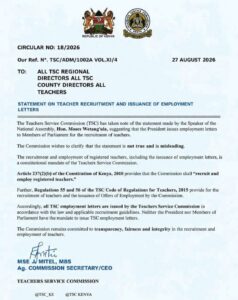
The Teachers Service Commission (TSC) has strongly denied claims linking the issuance of teacher employment letters to State House, insisting that the recruitment and employment of teachers remains exclusively under its constitutional mandate.
In a clarification issued on Thursday, August 27, 2026, the Commission described claims suggesting that the President or Members of Parliament issue TSC employment letters as untrue and misleading. The statement comes after remarks attributed to National Assembly Speaker Moses Wetang’ula sparked widespread public debate over the integrity and independence of teacher recruitment in Kenya.
TSC Moves to Clarify Teacher Employment Process
The controversy emerged after claims that Members of Parliament could receive teacher employment letters through State House before distributing them to beneficiaries in their constituencies.
The claims immediately raised serious questions among teachers, job seekers and members of the public, especially because the Teachers Service Commission is an independent constitutional commission with the responsibility of recruiting and employing teachers.
In its response, TSC made it clear that teacher employment is not a responsibility of State House or individual politicians. The Commission maintained that its mandate is protected by the Constitution and that teacher recruitment must follow the procedures established under the law.
According to reports on the clarification, TSC referenced Article 237(2)(b) of the Constitution of Kenya, which gives the Commission the responsibility to recruit and employ registered teachers. The Commission also pointed to the regulations that guide teacher recruitment and employment.
Why the Claims Caused Public Concern
The allegations attracted attention because thousands of trained and registered teachers across Kenya continue to wait for employment opportunities.
For many job seekers, securing a teaching position is a highly competitive process that depends on advertised vacancies, qualifications, registration requirements and other criteria established by TSC. Any suggestion that employment letters could be obtained or distributed through political channels therefore raises concerns about fairness and equal opportunity.
The controversy also revived debate about whether political influence could interfere with the recruitment of teachers. Some leaders and members of the public called for evidence and investigations into the claims, while others questioned how any arrangement involving politicians could operate alongside TSC’s constitutional independence.
TSC’s latest statement is therefore significant because it seeks to reassure teachers that the Commission remains responsible for the recruitment process.
TSC Says Its Recruitment Mandate Is Constitutional
The central message in TSC’s response is that the power to recruit and employ teachers does not belong to the President, State House or Members of Parliament.
Under Kenya’s constitutional framework, the Teachers Service Commission is mandated to recruit and employ registered teachers. This independence is intended to protect important decisions affecting teachers from improper external influence.
TSC said its position on the matter is guided by the law and the established regulations governing teacher recruitment.
The clarification means that teachers seeking employment should continue to follow official TSC recruitment procedures whenever vacancies are advertised. Applicants should be guided by official requirements and communication channels rather than individuals claiming to have the power to influence appointments.
The official TSC online recruitment system also states that teachers can apply for advertised positions online and track the processing of their applications. Importantly, the Commission warns applicants that no payment is required when applying for advertised teaching positions.
What the Denial Means for Job-Seeking Teachers
For unemployed and aspiring teachers, TSC’s clarification carries an important message: a teaching job should be pursued through the Commission’s official procedures.
Job seekers should be cautious of individuals who promise employment in exchange for money, political connections or other unofficial arrangements. Such promises can expose desperate applicants to fraud and financial losses.
Teachers should instead monitor official TSC advertisements, confirm information through the Commission’s recognised platforms and ensure that they meet the requirements for the positions they are applying for.
The Commission’s online services currently include teacher recruitment among the available services, providing applicants with an official channel for submitting applications when vacancies are advertised.
The latest controversy has also highlighted the need for greater transparency in public recruitment. Teachers and the public want confidence that appointments are made through clear, fair and verifiable procedures.
The Bigger Question of TSC Independence
Beyond the immediate disagreement over the alleged State House involvement, the controversy has placed the independence of TSC under renewed public scrutiny.
As an independent commission, TSC is expected to manage teacher recruitment according to the Constitution and relevant laws. Public confidence in this process is essential, particularly at a time when many trained teachers are competing for limited opportunities.
If job seekers begin to believe that political connections determine who gets employed, confidence in the recruitment system could be seriously damaged. This is why TSC’s decision to publicly reject the claims is likely to remain an important development in Kenya’s education sector.
The Commission has reiterated its commitment to transparency, fairness and integrity in the recruitment and employment of teachers. Its position is that the legal authority to recruit teachers rests with TSC, and that established procedures must be followed.
What Happens Next?
The public debate is unlikely to end with TSC’s clarification alone. The earlier allegations have already generated demands for accountability and for evidence supporting or disproving the claims.
However, TSC’s position is now clear: State House does not issue TSC teacher employment letters, and elected Members of Parliament do not have the constitutional mandate to recruit teachers on behalf of the Commission.
For teachers, the most important takeaway is to rely on official recruitment notices and avoid paying anyone who promises to secure a TSC job.
As the debate continues, attention will remain focused on whether further investigations, explanations or evidence will emerge regarding the claims that triggered the controversy.
What This Means for Teachers
The Teachers Service Commission has firmly denied claims linking the issuance of teacher employment letters to State House. By reaffirming that the recruitment and employment of teachers is its constitutional responsibility, TSC has sought to protect public confidence in the teacher recruitment process.
The controversy nevertheless raises wider questions about transparency, political influence and the protection of independent institutions. For thousands of teachers seeking employment, the message remains clear: follow official TSC procedures, rely on verified advertisements and never pay anyone for a promised teaching job.
TSC denies State House teacher employment claims.




[…] READ ALSO:TSC Denies State House Role in Teacher Employment Letters, Reaffirms Constitutional Mandate […]